At the School of Arts & Science (SAS), Chennai, the MCom curriculum is designed with an industry-oriented approach, bridging the gap between academic theory and real-world practice.
Last Updated:
10 months ago
Reviewed by:

SAS
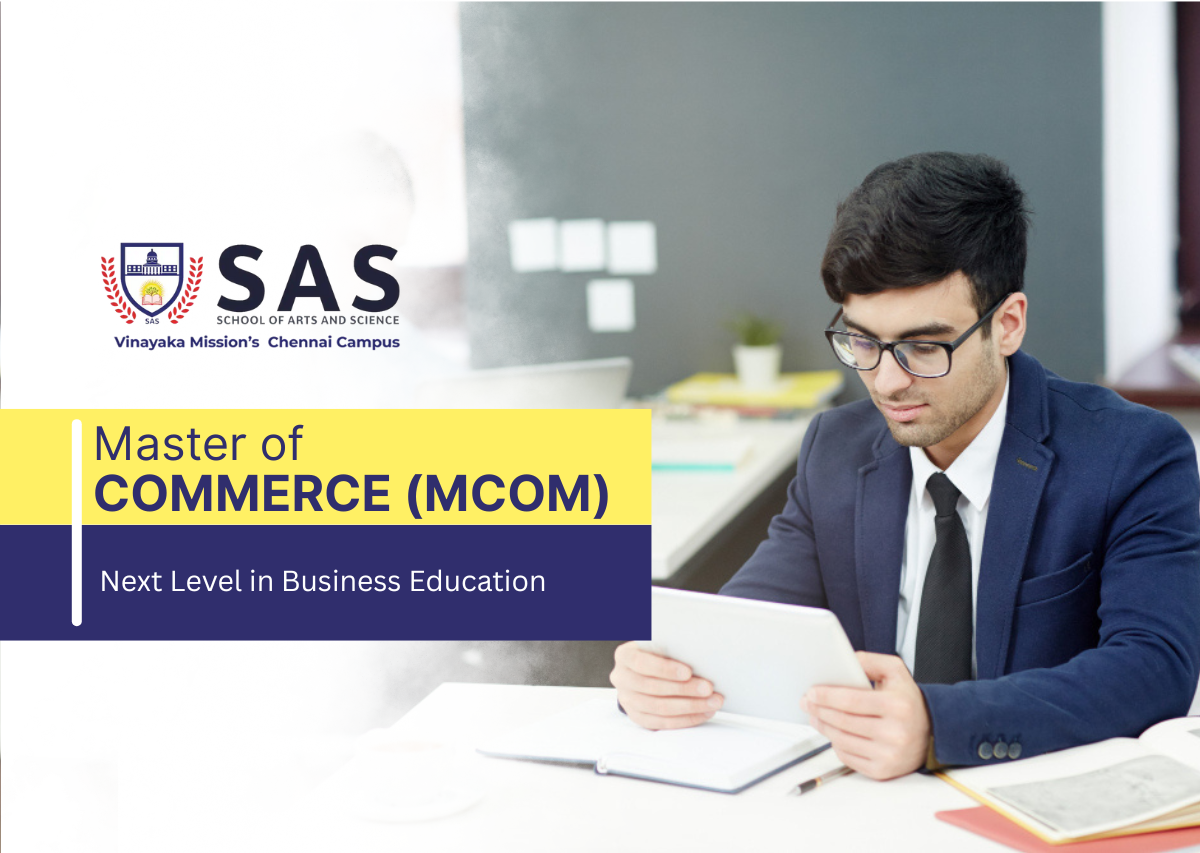
The Master of Commerce (MCom) is one of the most sought-after postgraduate degrees for graduates in commerce and related fields. It is designed to strengthen your expertise in areas like finance, accounting, economics, marketing, banking, taxation, and business management, along with specialized electives for career-focused learning.
This comprehensive guide covers everything you need to know about MCom – including course details, structure, subjects, eligibility, career prospects, salary trends, global opportunities, and more.
What is the MCom Full Form?
MCom stands for Master of Commerce. It is a postgraduate degree focusing on commerce, accounting, finance, economics, and business management. The MCom program aims to deepen students’ understanding of commercial and financial practices while building analytical and managerial capabilities essential for success in various sectors. SAS Chennai’s MCom course prepares graduates for dynamic roles by blending academic rigor with practical exposure.
What is MCom?
A two-year postgraduate degree that builds advanced expertise in commerce and business-related fields. While a BCom focuses on foundational principles, the MCom delves deeper into the strategic, analytical, and applied aspects of business, finance, and economics.
Primary Focus Areas:
Deepening conceptual understanding
Building managerial and decision-making skills
Providing hands-on exposure to industry-relevant practices
Why Pursue MCom in Today’s Career Landscape?
In today’s competitive job market, specialized knowledge is a key differentiator. MCom graduates enjoy:
-
Competitive salaries compared to many undergraduate degree holders.
-
Eligibility for top corporate and government positions.
-
Opportunities to pursue professional certifications like CA, CMA, CFA.
-
Strong foundation for academic and research careers.
-
A pathway to global and entrepreneurial opportunities.
Duration and Structure of MCom
| Aspect | Details |
|---|---|
| Course Duration | 2 years |
| Academic Structure | 4 semesters |
| Mode of Study | Full-time (Part-time/Distance available in some institutions) |
| Teaching Methods | Lectures, Seminars, Case Studies, Projects, Internships |
| Assessment Methods | Semester exams, Assignments, Presentations, Dissertation |
The full-time mode is recommended for immersive learning, networking, and placement opportunities.
MCom Program Curriculum
MCom courses are structured to balance theory with practical relevance.
Core Subjects (Common for all specializations):
Accounting for Managerial Decisions
Managerial Economics
Financial Management and Policy
Corporate Tax Planning
Research Methodology in Commerce
Organizational Theory and Behaviour
Marketing Management
Business Environment Analysis
Security Analysis and Portfolio Management
International Business
Elective & Specialization Subjects:
Institutions allow students to select electives from various specializations, ensuring subject expertise.
| Specialization | Key Topics Covered |
|---|---|
| Finance | Investment Analysis, Corporate Finance, Risk Management |
| Marketing | Consumer Behaviour, Advertising, Brand Management |
| Taxation | Direct Taxes, GST, Tax Planning |
| Human Resource Management | Performance Appraisal, Training & Development |
| Accounting | Advanced Corporate Accounting, Auditing, Cost Analysis |
| Banking & Insurance | Banking Laws, Risk Assessment, Insurance Policies |
| International Business | Export-Import Procedures, Trade Policy, Foreign Exchange |
| Computer Applications in Commerce | E-commerce, ERP Systems, Digital Business |
Skills Developed Through MCom
An MCom program emphasizes both soft and hard skills required in the professional world:
Soft Skills:
Communication & Presentation
Leadership & Teamwork
Analytical Thinking
Negotiation and Client Management
Hard Skills:
Financial Analysis
Advanced Accounting Practices
Data Interpretation
Market Research Techniques
Eligibility Criteria
| Requirement | Details |
|---|---|
| Academic Background | Bachelor’s degree in Commerce or related field (Economics, BBA, BBM) |
| Minimum Score | 50% aggregate (varies by institution; relaxation for reserved categories) |
| Entrance Exam (if applicable) | Some universities require tests like DUET, CUET-PG, BHU-PET, etc. |
| Age Limit | Generally none |
Admission Process
Step-by-step process:
Application Form – Fill online/offline form from the college/university portal.
Document Submission – Academic certificates, ID proof, photographs.
Entrance Exam (if applicable) – Some institutions shortlist through merit, others via entrance.
Merit List – Based on academic or exam scores.
Verification & Fee Payment – Secures your admission.
Career Opportunities After MCom
MCom opens career opportunities in both private and public sector.
| Sector | Job Roles |
|---|---|
| Private Sector | Accountant, Financial Analyst, Business Analyst, Tax Consultant, Investment Banker, Marketing Manager |
| Government Sector | Probationary Officer (PO) in Banks, Tax Inspector, PSU Roles, Lecturer in Government Colleges, Civil Services |
Private Sector Roles Explained
Chartered Accountant (with CA): Specializing in auditing & tax compliance.
Business Analyst: Translating business needs into actionable solutions.
Investment Banker: Structuring financial deals, mergers, IPOs.
Government Sector Roles Explained
- Bank PO/SO: Supervisory banking roles requiring financial understanding.
Tax Inspector: Assessment and recovery of direct or indirect taxes.
Civil Services: Prestigious administration roles for policy-making.
Higher Education & Certifications After MCom
Post MCom, graduates can consider:
PhD in Commerce/Management
MBA in Finance/Marketing/HR
Professional Certifications: CA, CMA, CS, CFA, CPA
Specialized Diplomas in fields like Logistics, Data Analytics, or Fintech.
Salary Trends
Factors affecting salary: Industry (Banking, IT, Consulting), specialization, skill set, and location.
| Experience Level | Average Salary (INR/year) |
|---|---|
| Fresh Graduate | 3 – 5 LPA |
| Mid-Level (3–5 years) | 6 – 10 LPA |
| Senior Roles (10+ years) | 12 LPA and above |
Global Opportunities for MCom Graduates
The MCom degree is widely accepted abroad, with opportunities in:
International Banking & Finance (London, Dubai, Singapore)
Global Trade Compliance
Financial Consultancy in MNCs
Policy Analysis & Research with organizations like IMF, UN agencies
Entrepreneurship Opportunities
An MCom graduate can start their own ventures in:
Accounting & Tax Consultancy
E-commerce Businesses
Import-Export Firms
Market Research Agencies
By combining industry knowledge with market insights, MCom graduates can develop sustainable business models.
Unique Advantage
For instance, the School of Arts & Science (SAS), Chennai offers an MCom program aligned with these academic and industry standards, blending theoretical learning with practical industry exposure to maximize career readiness.
FAQ's
To equip graduates with advanced professional knowledge in commerce, finance, and business management.
Some institutions admit graduates from allied fields like Economics, BBA, or BBM.
Yes, but coupling it with professional certifications (CA, CFA, CMA) significantly increases earning potential.
MCom is more academic and research-focused in commerce, while MBA is managerial and business administration-oriented.
Yes, especially when complemented with globally recognized certifications.
Strong — in consulting, tax services, fintech, and online businesses.
Yes, MCom qualifies you to appear for UGC-NET for a career in college-level teaching and research.
Never miss another article
Highly curated content, research, SAS updates, and more.
Keep Reading

Bachelor of Science (BSc) – Full Form, Course Details, and Career Path
Explore the Bachelor of Science (BSc) degree—full form, course duration, syllabus, eligibility criteria, top specializations, career opportunities, and salary trends in this 2025 comprehensive guide.

Bachelor of Computer Applications (BCA) – Complete Guide to Course Details, Career Scope, and Opportunities
The Bachelor of Computer Applications (BCA) is a 3-year undergraduate program that builds strong foundations in computer science, software development, and IT skills.
Master of Commerce (MCom)
At the School of Arts & Science (SAS), Chennai, the MCom curriculum is designed with an industry-oriented approach, bridging the gap between academic theory and real-world practice.